Mì Quảng: Vietnam's Turmeric Noodles, Made in Adelaide Chinatown
★ As featured in Glam Adelaide — 2025 SA Restaurant & Catering Awards finalist
Most people walk into a Vietnamese restaurant and order phở. Fair enough — it's the famous one. But tucked on our menu at Bà Năm, listed simply as "Quang-style turmeric noodles," sits mì quảng: a dish from central Vietnam that's less soup, more sauce, and one of the most distinctive bowls in the whole Vietnamese noodle family. If you've never tried it, this is your guide.
What is mì quảng?
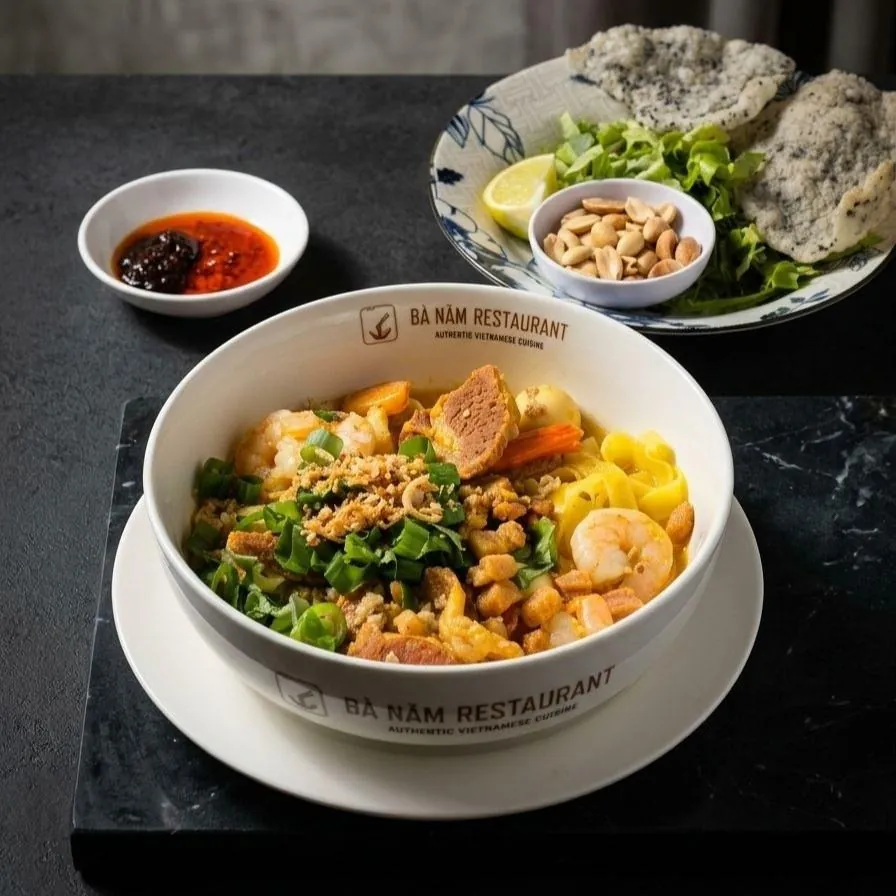
Mì quảng comes from Quảng Nam province in central Vietnam, the region around Đà Nẵng and Hội An. Its calling card is the noodle itself — wide, flat rice noodles tinted a warm gold with turmeric. The second thing you notice is what's not in the bowl: a full ladle of broth. Mì quảng is served with just a small amount of concentrated, intensely flavoured broth pooled at the bottom. You toss everything together and the noodles carry the flavour, rather than swimming in it.
Then comes the texture. Crushed peanuts, fried shallots, crisp rice crackers you snap over the top — mì quảng is a dish you hear as much as taste. It's rustic, generous food, the kind cooked for family gatherings and market lunches across central Vietnam for generations.
How it differs from phở, bún bò Huế and hủ tiếu
If you know your way around our menu, here's where mì quảng sits. Phở is the northern classic: flat rice noodles in a clear, deep beef broth — ours simmered for 18 hours, the recipe Bà Năm Lời cooked in her Trảng Bàng home kitchen back in the 1970s. Bún bò Huế is central Vietnam's other great export: round noodles, a spicy lemongrass broth, plenty of heat. Hủ tiếu Nam Vang is the southern-style bowl with Phnom Penh roots, lighter and sweeter, loaded with pork and prawn.
Mì quảng breaks the pattern on all three. Where those dishes are broth-forward, mì quảng is noodle-forward — the small amount of sauce-like broth is a seasoning, not a swim. Where phở is about clarity and restraint, mì quảng is about crunch, colour and contrast. It's arguably the least soup-like "noodle soup" in Vietnam, and that's exactly why people fall for it.
What's in the bowl at Bà Năm
The menu says "Quang-style turmeric noodles" and leaves it there, so here's the fuller picture. Ours is topped with prawns, tender pieces of pork and slices of fish cake over those turmeric-gold noodles, finished with spring onion, fried shallots and a good scatter of crushed peanuts. On the side you'll usually find rice crackers for snapping over the top, fresh lettuce, a wedge of lemon or lime and extra peanuts, with chilli sauce alongside so you set your own heat. It's $22, and it eats bigger than it looks.
The method is the fun part: squeeze the citrus, crumble in the crackers, add herbs and lettuce to taste, then toss the lot through that concentrated broth at the bottom. Every mouthful lands a bit different — that's the point.
A little recognition: Bà Năm was a finalist in the Vietnamese Restaurant category at the 2025 Hostplus SA Restaurant & Catering Awards, and Glam Adelaide featured the story behind grandma's recipes — later covering us in their 2025 Adelaide restaurants roundup as a finalist, not a winner, and we're happy to say it straight. We're not a luxury venue, just very genuine — but it's nice when people notice.
Part of a bigger noodle family
Mì quảng is one branch of a big tree. If you're working your way through Vietnamese noodle soups in Adelaide, the map roughly runs: phở from the north, bún bò Huế and mì quảng from the centre, hủ tiếu, bún riêu and the boldly fermented bún mắm from the south. Each region cooks to its climate and its markets, which is why no two bowls taste alike.
At Bà Năm, everything traces back to one kitchen — Bà Năm Lời's, in 1970s Trảng Bàng, Tây Ninh. Her grandson Huynh Nguyen brought those recipes to Adelaide in 2023, opening the restaurant with owner Thi Gai Vo. The care shows in details like the 18-hour bone broth and "red coin" beef in our Phở Tái — paper-thin rare beef that finishes cooking in the bowl — and in Huynh's Sunday farm runs to source local beef. Mì quảng gets the same treatment: no shortcuts, no fuss.
Trying it on Grote Street
You'll find us at 65 Grote Street in Adelaide's Chinatown, open seven days from 11:00 AM to 9:00 PM (9:30 PM through summer, October to March), public holidays included. Walk-ins are welcome, though at peak times we'd rather be upfront: the wait can run 15 to 30 minutes. You can book through OpenTable, and groups of eight or more should call ahead on (08) 8151 0106. Prefer to order in? The app lives at order.phobanam.com.au.
Mì quảng suits any season, but a bowl with a Vietnamese iced coffee on a warm Adelaide day is hard to beat — and if the weather turns, our winter warmers have you covered too.
Worth stepping off the phở path
We'll always be a phở house at heart — but mì quảng is the dish we quietly hope more Adelaide diners discover. It's different, it's textural, and it tells a story from a part of Vietnam that doesn't always get the spotlight. Next time you're exploring Vietnamese food in the Adelaide CBD, look past the top of the menu. The gold noodles are waiting.
Frequently asked questions
What is mì quảng?
Mì quảng is a noodle dish from Quảng Nam province in central Vietnam, made with wide turmeric-tinted rice noodles and a small amount of concentrated broth — more sauce than soup — topped with proteins, herbs, peanuts and crispy rice crackers.
How much is mì quảng at Bà Năm?
Mì quảng is $22 at Bà Năm. Ours is topped with prawns, pork pieces, fish cake, spring onion, fried shallots and crushed peanuts, with rice crackers, lettuce, citrus and chilli sauce on the side.
How is mì quảng different from phở?
Phở is a clear, broth-forward soup, while mì quảng uses only a small pool of concentrated broth at the bottom of the bowl. Mì quảng also uses turmeric-gold noodles and leans heavily on crunchy textures like peanuts and rice crackers.
Do I need to book to try mì quảng at Bà Năm?
Walk-ins are welcome, though the wait can be 15 to 30 minutes at peak times. You can book through OpenTable, and groups of eight or more should call ahead on (08) 8151 0106.
Where is Bà Năm and when is it open?
Bà Năm is at 65 Grote Street in Adelaide's Chinatown, open seven days from 11am to 9pm (9:30pm during summer, October to March), including public holidays.