Rice Paper Rolls in Adelaide: Gỏi Cuốn, Chả Giò and the Difference
★ As featured in Glam Adelaide — 2025 SA Restaurant & Catering Awards finalist
Order "spring rolls" at five different Adelaide restaurants and you might get five different things — fresh, fried, hot, cold, wrapped in lettuce or rolled in pastry. The confusion is understandable, because in Australia the names rice paper rolls, cold rolls, spring rolls and summer rolls get used almost interchangeably. Behind them all sit two very different Vietnamese dishes: gỏi cuốn, the fresh one, and chả giò, the fried one. At Bà Năm on Grote Street we serve both, each at $14 — so here's how to tell them apart and order exactly what you're craving.
One wrapper, two very different rolls
Both rolls start from the same humble sheet: bánh tráng, the thin Vietnamese rice paper made from rice flour and water and dried in the sun. From there, the two dishes head in opposite directions — one stays soft and fresh, the other goes into hot oil.
Gỏi cuốn — the fresh one
Gỏi cuốn (literally "salad roll") is what most Australians mean by rice paper rolls or cold rolls. The rice paper is softened in water, rolled around a fresh filling and served at room temperature — never fried. The classic Saigon build pairs poached prawn and pork with rice vermicelli, lettuce and fresh herbs, the translucent wrapper showing off the pink of the prawns inside. Ours is the Gỏi Cuốn Tôm Thịt: three generous cold rolls of prawn and pork for $14, made to order rather than pulled from a display fridge. Traditionally they're dunked in a dipping sauce — a sharp nước chấm or a rich peanut-hoisin style — and eaten in two or three big bites. Light, bright and herb-forward, they're the freshest way to open a Vietnamese meal, and because rice paper is naturally made from rice, they suit plenty of gluten-wary diners too. As always, let our staff know about any allergies when ordering and we'll steer you right.
Chả giò — the crispy one
Chả giò is the southern Vietnamese fried spring roll. The filling — ours is pork and chicken — is rolled tight and fried until the wrapper blisters and shatters. Bà Năm's Chả Giò Thịt gives you four rolls for $14. Eat them the Vietnamese way: wrap a hot roll in a lettuce leaf with a few herbs, dip it, and take the whole parcel in one go. That three-way contrast — crisp pastry, cool lettuce, salty-sweet sauce — is the entire point of the dish. In northern Vietnam the same roll goes by nem rán; on Adelaide menus you'll usually see it listed simply as fried spring rolls.
Cold rolls, summer rolls, spring rolls: sorting out the names
Here's the cheat sheet. In Australia, rice paper rolls and cold rolls almost always mean gỏi cuốn — fresh, soft, uncooked. Americans call the same dish summer rolls or fresh spring rolls, which muddies the waters when you're reading recipes online. The words spring rolls on their own, on an Australian menu, usually point to the fried kind. The Vietnamese names cut through all of it: gỏi cuốn is fresh, chả giò is fried. And if in doubt at Bà Năm, just tell us fresh or fried — we'll take it from there.
Vegetarian versions of both
Both rolls come meat-free, at the same price and made with the same care. Gỏi Cuốn Chay (three rolls, $14) swaps the prawn and pork for golden pan-seared tofu, and Chả Giò Chay (four rolls, $14) is its crispy counterpart. They sit within a larger plant-based line-up — vermicelli salad bowls among them — which we've covered in detail in our guide to vegetarian Vietnamese food in Adelaide.
When a starter becomes a meal: bún chả giò
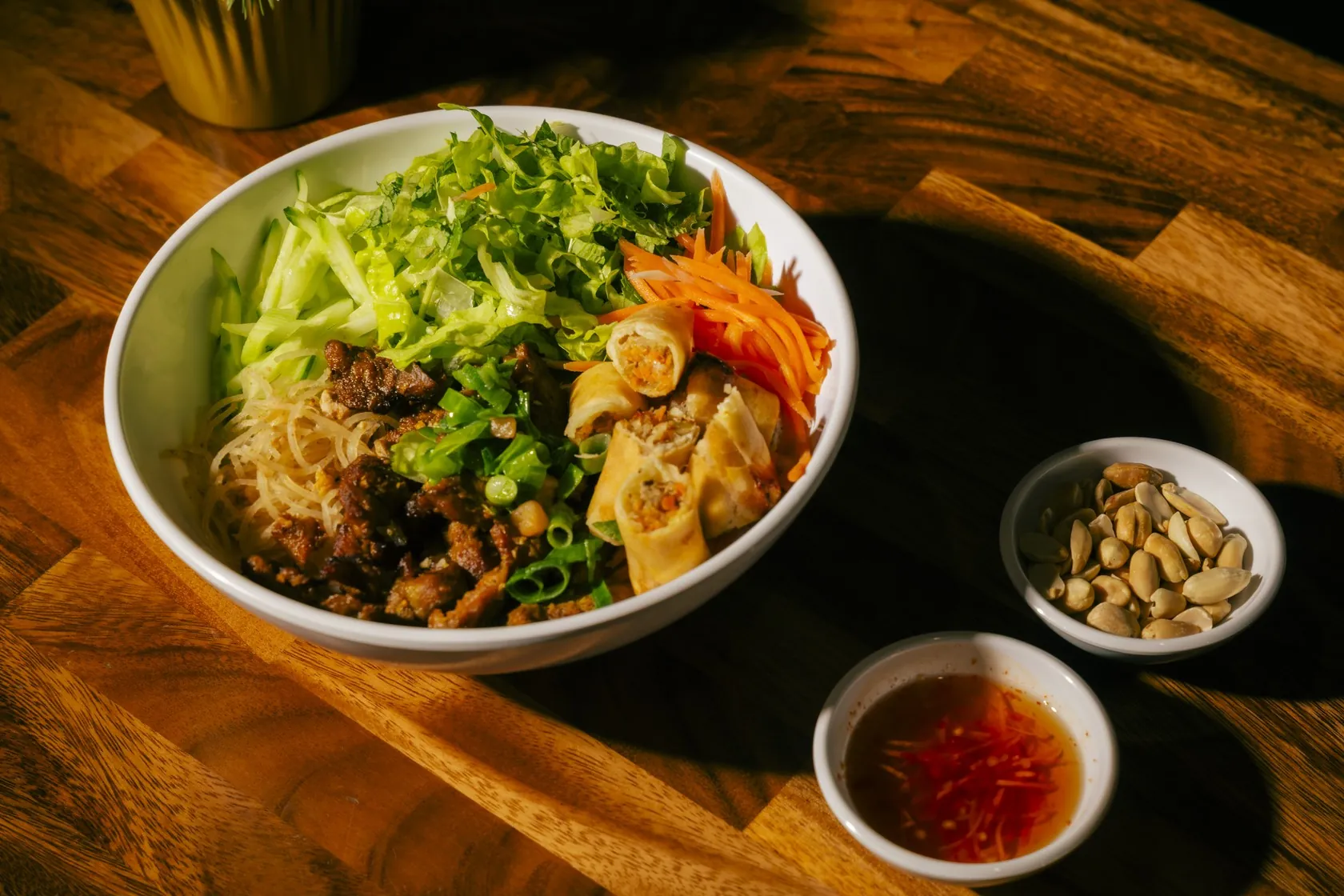
Vietnamese kitchens don't confine chả giò to the starters list. Bún Chả Giò ($20) turns the roll into a full meal: a bowl of rice vermicelli over crisp salad and herbs, topped with sliced hot spring rolls. It eats light but satisfying — the fried crunch against cool noodles is what keeps you coming back. There's a vegetarian version too (Bún Chả Giò Chay, $20), and if the table wants more crunch you can add extra chả giò to anything, two rolls for $6. For the full vermicelli family — including grilled-pork bún thịt nướng and grilled-chicken bún gà nướng — see our dedicated bún chả giò guide.
What to eat after the rolls
Rolls are the opening act. If the table wants more fried crunch beside them, Hoành Thánh Chiên fried wontons (six for $14) or Bánh Mì Tôm Chiên prawn toast (three for $14) land hot with chilli dipping sauce. The traditional next move is a bowl of phở — and ours is the reason most people find us. Phở Tái is paper-thin rare beef laid raw over the noodles and cooked in seconds by boiling 18-hour bone broth, from $20 (large $22), or $25 in the signature stone bowl that arrives at the table still bubbling. A plate of gỏi cuốn on the table while the phở lands is about as good as ordering gets. You can read the full story of our phở tái and the red coin in our bone broth & red coin article.
As featured in Glam Adelaide. Bà Năm was named a finalist in the 2025 Hostplus SA Restaurant & Catering Awards for Excellence (Vietnamese Restaurant category) and featured by Glam Adelaide — recognition for the family recipes, the locally sourced beef, and Huynh's Sunday farm runs that keep the kitchen honest.
Where to get rice paper rolls in Adelaide CBD
You'll find Bà Năm at 65 Grote Street, in Adelaide's Chinatown — a short walk from Victoria Square / Tarntanyangga and the Central Market. We're open seven days a week, 11am to 9pm (until 9:30pm in summer, October to March), including public holidays. Walk-ins are welcome, and you can book online via OpenTable. We'll be straight with you: at peak times there's usually a 15–30 minute wait for a table, though the rolls come out fast once you're seated. Larger group (8 or more)? Call ahead on (08) 8151 0106. If you'd rather eat at home, order pickup online at order.phobanam.com.au, or find us on Uber Eats and DoorDash. And for the full lie of the land — what else to order and when to come — see our guide to Vietnamese food in the Adelaide CBD.
Want the full deep-dive on fresh rolls? Our dedicated Gỏi Cuốn Tôm Thịt guide covers the prawn-and-pork cold rolls, peanut dipping sauce, vegetarian gỏi cuốn chay, and how they fit a Bà Năm meal — three cuốn for $14.
Frequently asked questions
What's the difference between gỏi cuốn and chả giò?
Gỏi cuốn is the fresh one — soft rice paper rolled around prawn, pork, vermicelli and herbs, served cold. Chả giò is the fried one — a crispy spring roll with a hot pork and chicken filling. Same rice paper, opposite directions.
Are the rice paper rolls gluten-free?
Rice paper is naturally made from rice flour, so fresh gỏi cuốn suit many gluten-wary diners. We're not a certified gluten-free kitchen, though, so please tell our staff about any allergies or intolerances when you order and we'll guide you honestly.
Is there a vegetarian option?
Yes — both rolls come meat-free. Gỏi Cuốn Chay (three fresh rolls) and Chả Giò Chay (four fried rolls) are each $14, and there's a vegetarian Bún Chả Giò Chay vermicelli bowl for $20.
How much do the rolls cost at Bà Năm?
Gỏi Cuốn Tôm Thịt (three fresh rolls) is $14, Chả Giò Thịt (four fried rolls) is $14, and the vegetarian versions are $14 each. Extra chả giò are $6 for two, and Bún Chả Giò is $20.
Is there a wait at peak times?
Walk-ins are welcome, and you can book online via OpenTable. At peak times there's usually a 15–30 minute wait for a table. We're open seven days, 11am to 9pm (9:30pm October to March). Groups of 8 or more should call ahead on (08) 8151 0106.